VIEWS: 765
December 10, 2025Aleta Ringlero Provides Insight During ‘America at 250’ Event
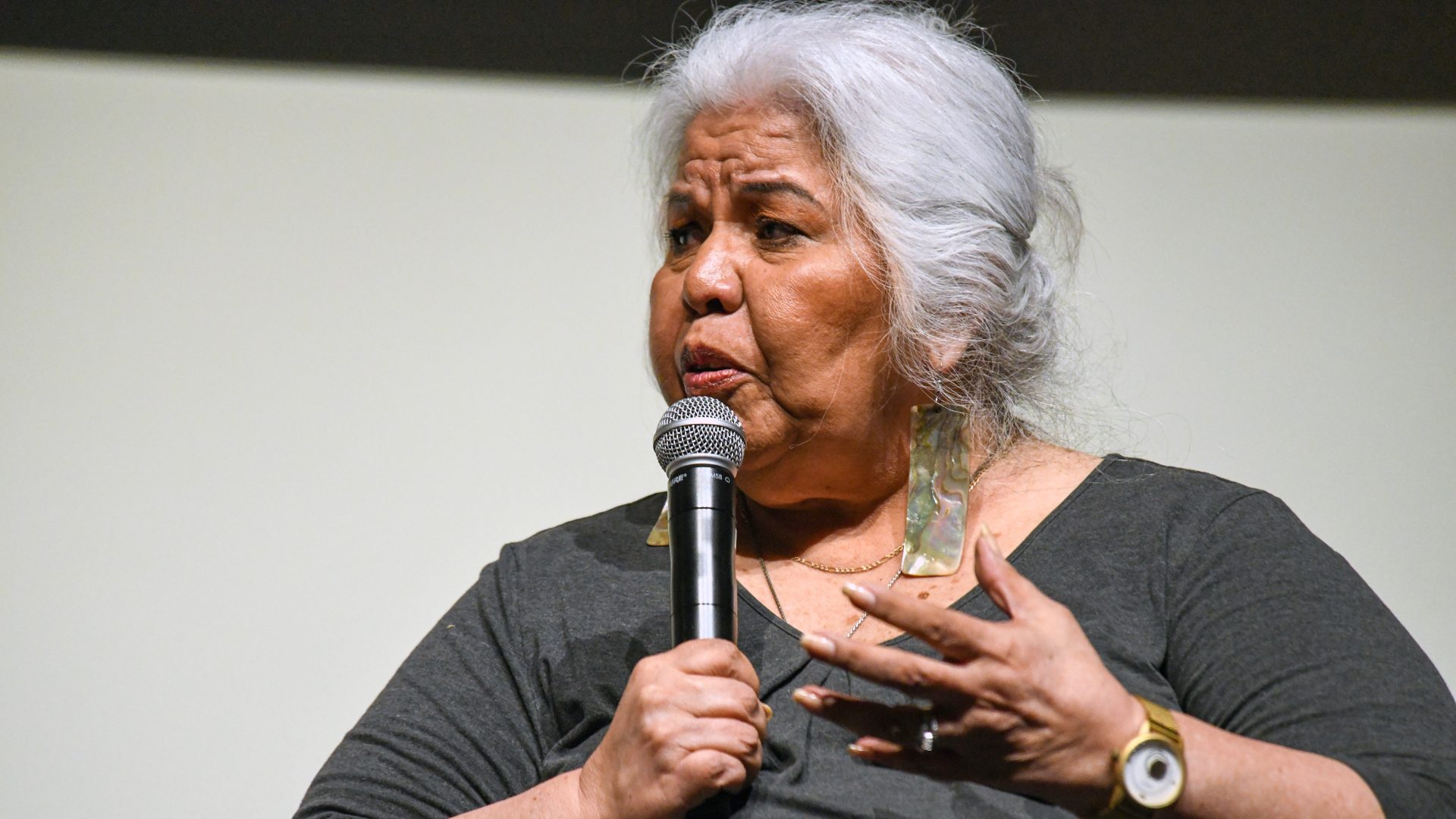
Ringlero was selected to provide insight at a lecture titled ‘America at 250: Indigenous Voices,’ hosted at Phoenix’s Heard Museum on Nov. 12 in collaboration with Arizona State University and PBS.
3 Takeaways:
- The United States will celebrate its 250th birthday in July 2026.
- Salt River Pima-Maricopa Indian Community senior Aleta Ringlero served on a panel that discussed Indigenous insights about America’s inception.
- The event was part of the world premiere of the new PBS film “The American Revolution,” produced by Ken Burns, Sara Botstein and David Schmidt.
America is celebrating its 250th birthday next year. Are you ready?
A new 12-hour documentary film by Ken Burns, Sara Botstein and David Schmidt titled “The American Revolution” received its world premiere on PBS on Nov. 16.
Days before, on Nov. 12, an exclusive screening was held at the Heard Museum in Phoenix at which Salt River Pima-Maricopa Indian Community senior Aleta Ringlero, a curator, author, art historian and calligrapher, participated in a panel discussion that also included Maurice Crandall (Yavapai Apache Nation) and Manuel Pino (Acoma Pueblo).
The exclusive presentation was a collaboration between the Heard Museum, Arizona State University and PBS. The event featured excerpts from the film, as well as a panel discussion which covered the roles that Indigenous communities played during the American Revolution.
Carol Yancho, senior director of content at Arizona PBS, served as the moderator during the discussion. Arizona Secretary of State Adrian Fontes also provided remarks.
Ringlero previously directed the Native American Public Programs office for the Smithsonian’s National Museum of Natural History in Washington, D.C., in addition to working with the California State Railroad Museum as well as the Tahoe National Forest.
It is important to understand that Indigenous communities are the original caretakers of the land we today call the United States. The impacts of colonization forced Indigenous communities to lose their languages, traditions and histories, which has left a dark stain on America’s history and its origins 249 years ago.
The Film
“The American Revolution” features some of Hollywood’s top talent as voices and narrators. Tom Hanks, Michael Keaton, Meryl Streep, Josh Brolin, Samuel L. Jackson and Jon Proudstar are just a few of the many actors featured in the film. Across six feature-length episodes, the documentary covers U.S. history starting from May 1754.
The film uses archival materials to feature perspectives from the people involved at the time, including military personnel and members of Indigenous communities.
Filmed over the course of a few years, the documentary combines audio, video and photographs to detail and showcase the inner workings of how this country came to be.
Ringlero’s Insight
“The year 1776 has very little meaning in terms of Indigenous awareness,” began Ringlero. “As a member of an Indigenous community, our concerns at that time were more about daily living—our families, our farms. We are incredible farmers.”
The Onk Akimel O’odham and Xalychidom Piipaash were responsible for creating the sophisticated canal system which laid the groundwork for the Phoenix Valley’s irrigation system in use today. The canals supported farming of corn, beans, squash and cotton, with some irrigation canals reaching 15 miles long.
Ringlero continued, “The daily life of the people is what concerned our communities; how we get along with each other. In terms of Arizona, some of the finest examples of how tribal people got along are represented by the communities here that were present at that time and continue in modern-day Indian Country.”
She added, “There was a system of cooperation that existed, not only between our tribal communities, but also tribes that we traded, intermarried and traveled with. I think, for the East Coast, it is centric around the British and the Americas. Arizona is something completely different. Fortunately, we didn’t have the [American Revolution], the Battle of Bull Run or Gettysburg. But we did have the Pima Revolt of 1751.”
The Pima Revolt of 1751 was a battle between the O’odham and Spanish settlers that began on Nov. 21, 1751. The conflict occurred in the Santa Cruz and Altar river valleys, located in southern Arizona and northern Sonora, Mexico.
The revolt was a result of decades of abuse and mistreatment of the O’odham by the Spanish and is considered one of the largest coordinated Indigenous revolts in the Southwest.
Check your local PBS listings for showtimes to view “The American Revolution.”