VIEWS: 517
August 9, 2026Melchor Solis Facilitates Webinar on Personal Improvement, Reflection
3 Takeaways:
- The webinar was hosted by Inter-Tribal Council of Arizona Project Manager Kelly R. Vallo, MSW.
- Salt River Pima-Maricopa Indian Community member Melchor Solis explained how to increase personal reflection while being a good role model for youth.
- The presentation was part of a webinar series featuring Indigenous presenters.
When was the last time you wrote a love letter to yourself? It might be time to try it out.
On June 23, the Inter-Tribal Council of Arizona hosted a webinar titled “Protecting Our Relatives: A Reflection of Ourselves.”
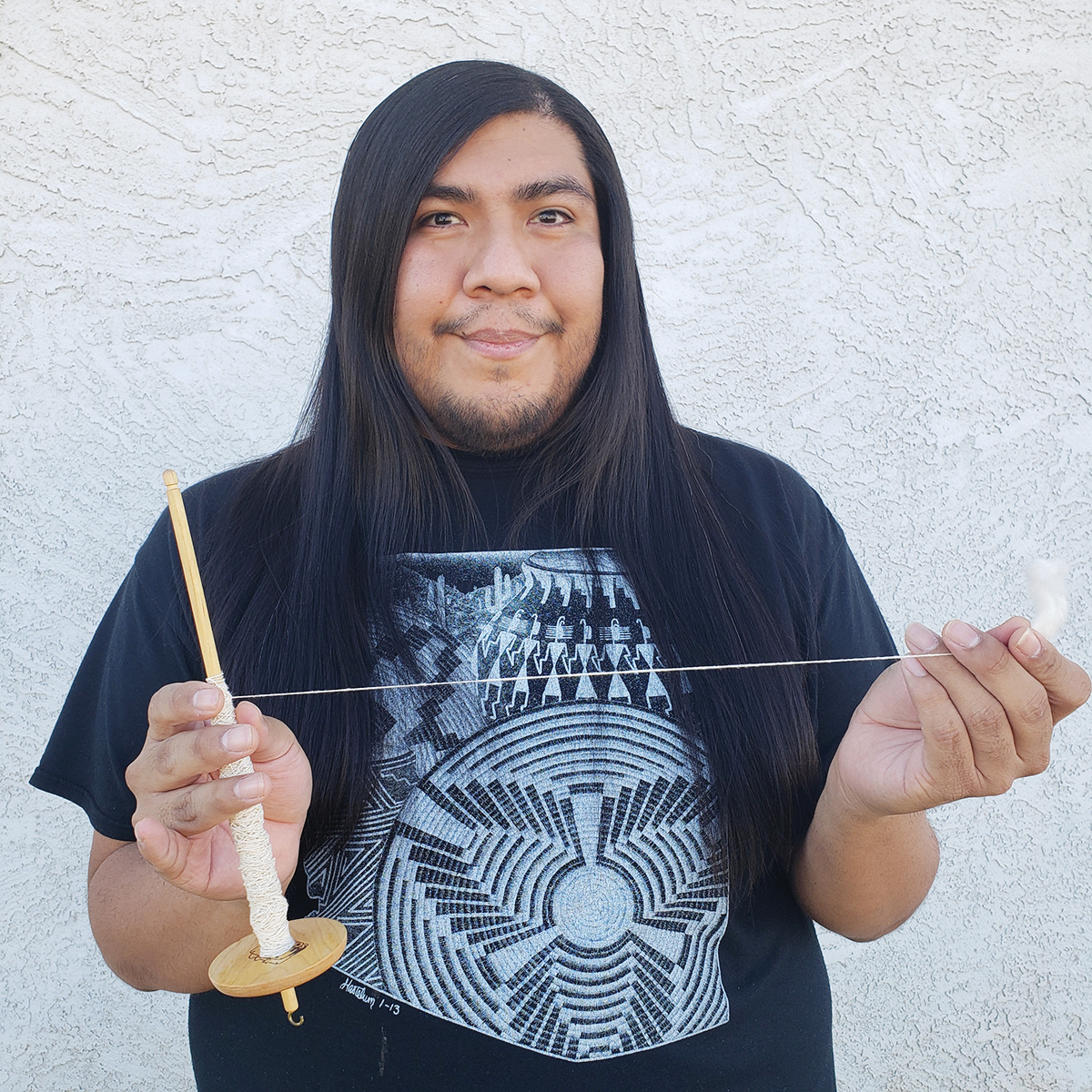
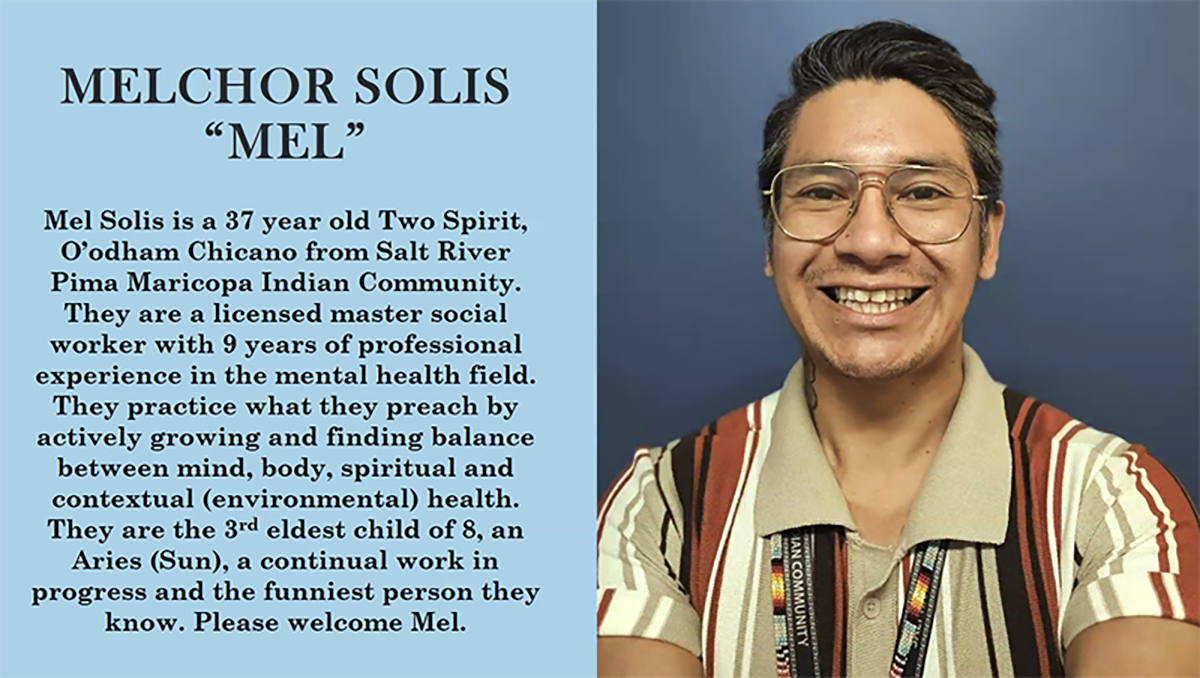
Salt River Pima-Maricopa Indian Community member Melchor Solis facilitated the Zoom presentation to nearly 30 attendees.
Solis greeted the class and ensured that their presentation originated from a place of love. “If some of the things I talk about are new to you, may this be a nudge to you and come from a place of curiosity, because when we learn better, we do better,” they began.
Solis wore their heart on their sleeve for all to see during the presentation, revealing the tough times they experienced in their 20s and how they overcame tragic moments, turning them into life lessons.
“When I was 21, I moved to Portland,” Solis said. “That’s where I learned to be my own person. [But] I made a lot of mistakes. I broke my hand twice fighting.”
Eventually, Solis reached a crossroads.
“One day, I woke up in jail. I realized I could not live my life like that, so I went back to school.”
In 2020, Solis earned a master’s degree in social work and found employment in various departments in the SRPMIC, including the River People Health Center and the Ske:g Himdag Ki.
After turning their life around and focusing on helping themselves and others, Solis shared with the group that they have recently returned to college with plans of earning their Ph.D.
“To understand a person, you have to look at their whole environment,” said Solis. “Much like a lot of you, I was born and raised in Arizona and came from a childhood filled with addiction, domestic violence and more. I was also born to parents that showed me how to push myself and seek the change I wished to see in my life.”
A way to understand someone’s environment is to learn more about how different systems impact a person’s life. This is where Solis’ near-decade worth of experience came into play.
“There’s the microsystem, which is someone’s ethnicity, temperament and physical abilities. The ecosystem is a person’s social settings, like churches, community health services and parents’ workplaces. The macrosystem is the laws in place in a society, cultural values in a community, and the norms and customs of a larger society. Finally, there’s the chronosystem, or dimensions of time, which include puberty, getting married, and generational traumas like boarding schools and tragedies like Sept. 11, 2001.”
Solis emphasized to the group that humans are complex and each of these systems impacts a person’s life, even if they may not realize it. “Everything is interconnected,” they said. “What happens in one area of life will happen in others. The only constant is change.”
They continued to detail that loss of sleep, eating problems and experiencing bouts of depression negatively impact our minds and bodies.
Solis then asked this question to the group: “Has anyone here ever written a love letter to yourselves?”
Nobody raised their hands. “That’s okay,” said Solis.
They continued, “Writing a love letter to yourself is a great way to practice telling things to yourself that you might not hear from others. It also gives you an example of what you can tell others.”
Solis read an excerpt from his personal love letter, which detailed the challenges they overcame and how they turned learning experiences into teachable lessons.
Later, Solis provided two minutes for the webinar group to try writing a love letter to themselves. For many, it was the first time they’ve done something like this.
As the webinar came to a close, Solis concluded by teaching the class how to properly ground themselves, an exercise that helps control breathing and can aid in de-escalating the mind.
“Movement is medicine,” said Solis. “Being aware of our bodies is when we realize we need to take a walk or a break. This is how we can uplift each other and have healthy conversations. This is how we can be good examples for the youth and ourselves.”