VIEWS: 250
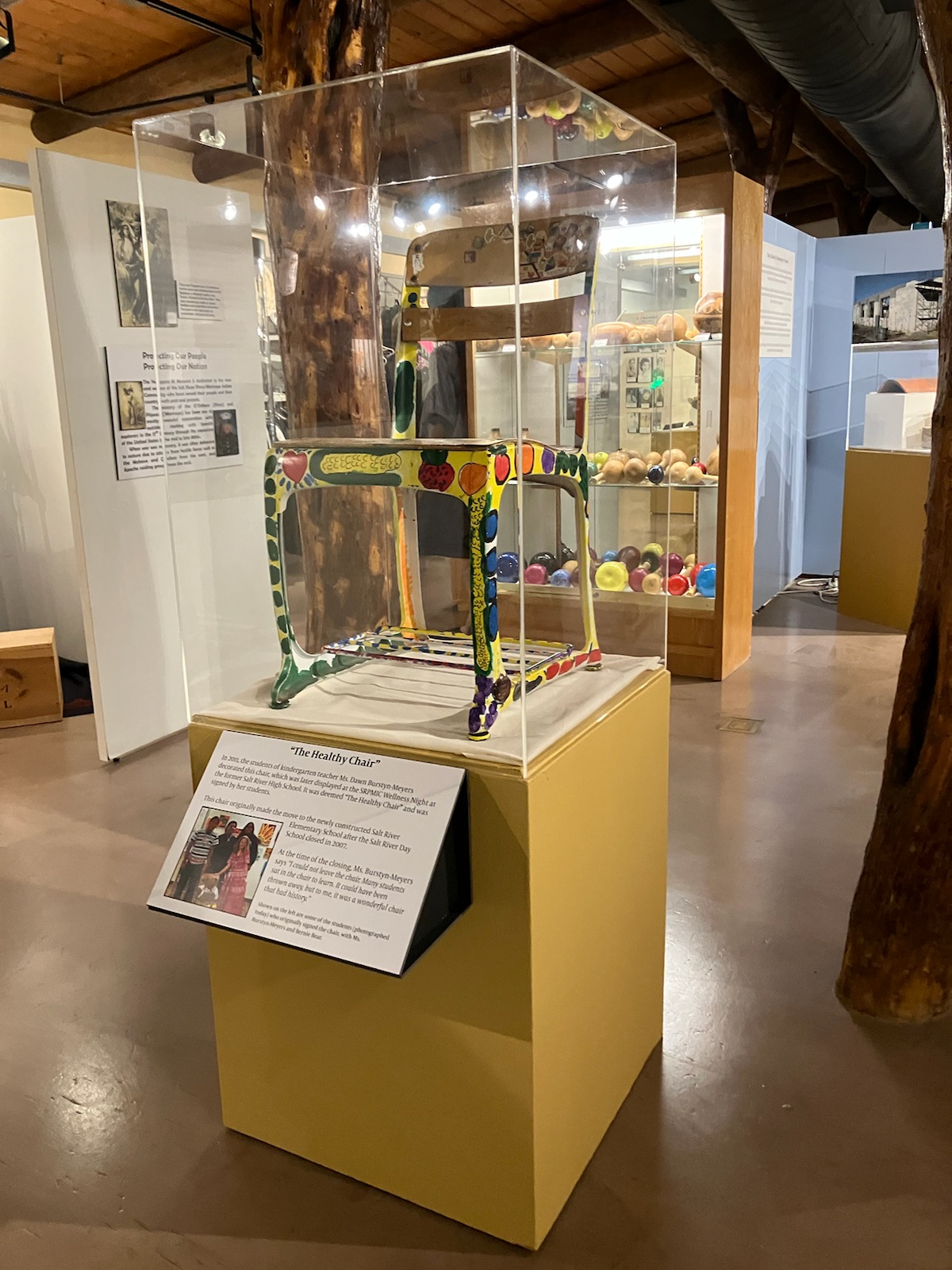
September 28, 2026Healthy Chair on Display at Huhugam Ki: Museum
If you talk to enough Salt River Pima-Maricopa Indian Community members of a certain age about “the Healthy Chair,” they will know exactly what you are referring to. You are bound to evoke a reaction similar to “I remember that chair!”
You could be learning about the chair for the first time right now and wonder if you might have sat in it in one of its previous lives.
Now, the Healthy Chair has its own front-row seat as part of the Huhugam Ki: Museum’s “Good Morning Class. A History of Salt River Day School” exhibition, which is open for visitors to experience.
Salt River Elementary School teacher Dawn Burstyn-Meyers, known by her students as Mrs. Meyers, found the “old chair” in 2007 at the Salt River Day School when it closed and brought it to the new SRES location. The chair was destined for the landfill, but the whimsically wise Meyers had the foresight and an idea to later repurpose the chair.
In the 2010-2011 school year, Meyers pulled the chair forward for a kindergarten lesson on developing good eating habits.
“The chair became their piece of art with healthy foods, vegetables and fruit on it and hopefully inspired them to maintain healthy eating habits throughout their lives,” said Meyers.
Memories remained strong for Meyers when she reminisced about the conversations with students, which included topics like healthy foods to eat, getting your exercise and drinking plenty of water. Each student painted either a design or healthy food on the chair and signed the seat. The chair was displayed at a Wellness Night event at Salt River High School.
Displaying a Team Effort
Visitors can check out the yellow-painted school chair on display at the Huhugam Ki: Museum during normal business hours, Monday through Friday, 9:30 a.m. to 4:30 p.m. The museum is in the Community at 10005 E. Osborn Road.
On March 13, Museum Collections Manager Franak Hilloowala and Museum Collections Assistant Phillip Raphael picked up the chair from Meyers’ classroom. In a symbolic gesture, former students Antonio Valencia, Lamar Lopez and Sighman Schurz helped carry the chair out.
“Mrs. Meyers played an important role as well in preserving the chair’s story, history and provenance for us,” said Raphael. “Before it made its way to the Huhugam Ki: Museum, she took care of the chair at the SRES and provided us with photos and documentation showing the chair with her students and information regarding the chair’s history. These are important for us in properly documenting the object’s history for the generations to come.”
Once it arrived at the Cultural Repository, Raphael assisted in bagging the chair so it could be treated for possible insect or mold contamination. Then the team catalogued the chair, took photos of it and housed it in the museum’s permanent collections. He even assisted Museum Archivist Steve Hoza with installing the chair in the gallery.
Raphael said it was meaningful to be involved from beginning to end.
“This was a good example of the work we do behind the scenes when acquiring an object in general and putting an object on display,” he said.
The exhibition was curated by Museum Archivist Assistant Elisa Pongyesvia, who wanted to celebrate the children who attended the Day School, which was recently resurrected as the Kavaḍ/Kushov Cultural Center.
“Working in the archives, I utilized photography, audio and video recordings as just one part of telling their story, but I felt the Healthy Chair is a noteworthy piece to include as it is reflection of the children’s resilience and creativity,” shared Pongyesvia.
Hoza repainted the exhibit case base and Pongyesvia had a new acrylic top for the case made for the chair. Pongyesvia wrote the label text and Hoza created the label mount and secured it to the case.
Like Raphael, Pongyesvia gave props to Meyers for serving as the caretaker of the chair.
“In working with Mrs. Meyers, she has always been an advocate for self-expression in our Community’s youth. Thanks to her passion, we have another piece of Community history that serves as a tribute to many children’s fond memories of days spent learning,” said Pongyesvia.
The Repository is hoping to grow its collection of items related to the Salt River Day School. If anyone is willing to donate or share items or experiences, please reach out by email to HuhugamkiMuseum@SRPMIC-nsn.gov.