VIEWS: 758
December 29, 2025Deb Haaland Delivers Lecture at ASU Sandra Day O’Connor College of Law
The former U.S. Interior secretary delivered the 16th annual William C. Canby Jr. Lecture in November, highlighting her public service career in addition to shining a light on the important role Indian Country plays in today’s political and judicial policy.
3 Takeaways:
- Deb Haaland served as the 54th U.S. Interior secretary during the Biden administration.
- The annual lecture promotes tribal sovereignty and self-governance for students at the Arizona State University Sandra Day O’Connor College of Law.
- Former speakers at the annual William C. Canby Jr. Lecture include Kristen Carpenter, director, American Indian Law Program, University of Colorado Law School (2021-2022); Herb Yazzie, chief justice, Navajo Nation Supreme Court (2010-2011); and Diane Enos, former president of the Salt River Pima-Maricopa Indian Community (2008-2009).
On Nov. 26, lawyers, law school students, current and former tribal officials, and many more made their way to the W.P. Carey Foundation Armstrong Great Hall at the Sandra Day O’Connor College of Law at Arizona State University’s downtown Phoenix campus for a special lecture.
The annual lecture is named after William C. Canby Jr., a founding faculty member of ASU’s Sandra Day O’Connor College of Law and the Indian Legal Program. The lecture gives current and upcoming lawyers and leaders an opportunity to connect with policymakers while ensuring the perspectives of Indian Country are upheld.
Patty Ferguson Bohnee, faculty director of the ASU Indian Legal Program, welcomed guests to the annual lecture.
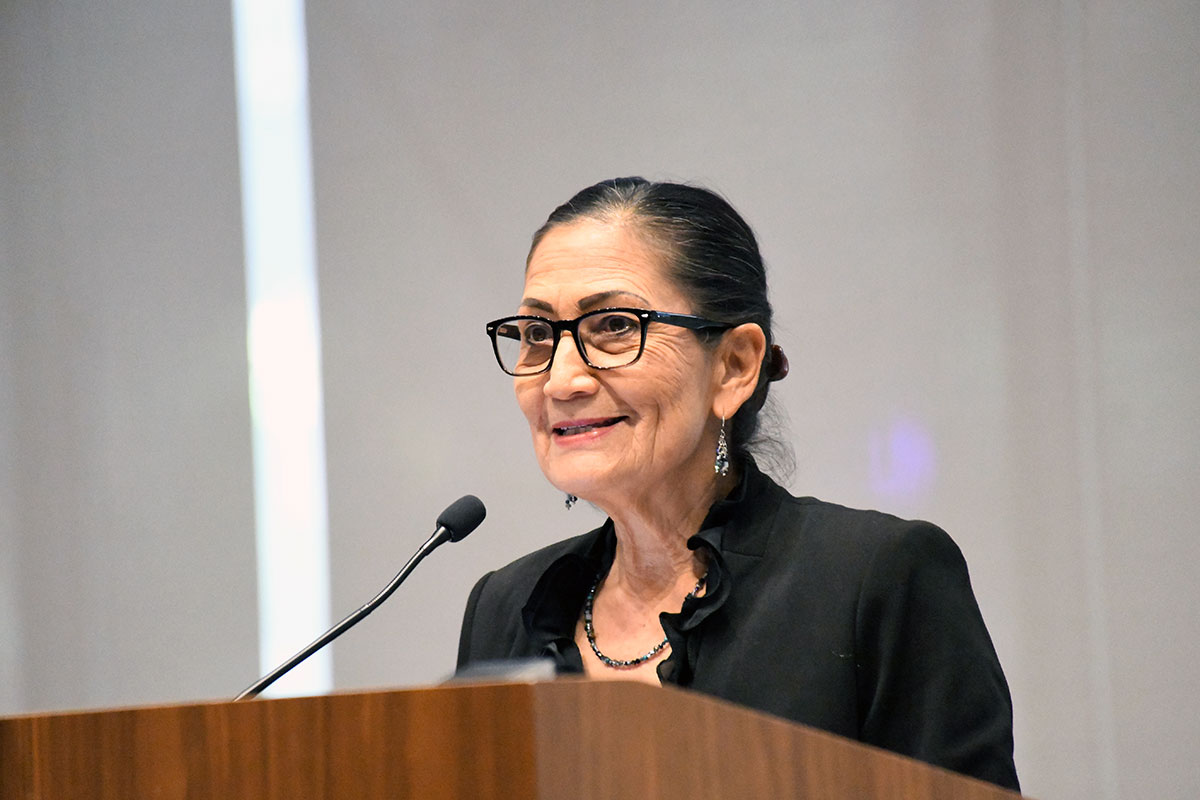
This year’s invited guest speaker was Deb Haaland, who served as secretary of the U.S. Department of the Interior from 2021 to 2025. Her lecture was titled “A Path to A New Era: Indigenous Leadership.”
Born in Winslow, Arizona, Haaland (Laguna Pueblo) is running for governor of New Mexico as a Democrat in next year’s election. She was one of the first Indigenous women to serve in the U.S. House of Representatives prior to her role at the Interior Department.
“It’s such an honor to be back in Arizona, the state where my grandparents spent 45 years working on the railroads because of America’s forced assimilation policies, which led to my birth in Winslow,” began Haaland.
She continued, “We’re also a stone’s throw away from the Gila River Indian Community, the location where the president of the United States apologized for our country’s role in the federal boarding school era.”
During her prepared remarks, Haaland paid respects to Judge Canby, who was in attendance with his wife, Jane. “When Indian Country relied on our allies, Judge Canby was there, fighting the good fight, making fair and good decisions. Judge Canby, your life’s work has changed our country for the better. Thank you.”
Haaland also addressed the law students who will one day graduate and become lawyers. “In my view, leadership quality matters even more than just having ego or self-interest. Good leadership is imperative—those who care about the many and not just the privileged.
“Native people are our country’s first land stewards. Leadership in our communities requires genuine care. Indigenous leadership should ensure the adults in the room work hard to leave generations to come with a sustainable future that nurtures the values of community and prosperity that our ancestors held dear.”
She later detailed that her pueblo is a matrilineal one. When she was growing up, she said, her mother oversaw the household. “Even if my dad thought he was in charge,” said Haaland with a smile.
“Indigenous leadership is not about the individual,” added Haaland, “but rather our people collectively and the power we have when we work together. Indigenous people do not work to exclude people; instead, we strive to fight for everyone, the land and our non-human relatives. Because we know that we are more capable to tackle the challenges we face if we work together.”
Haaland received a standing ovation from the crowd as her speech came to an end.
Later, during a question-and-answer panel discussion, Haaland fielded questions about water rights, artificial intelligence and the status of the national Native American Boarding School coalition under the Trump administration.