VIEWS: 417
August 27, 2026Shocking Stuff: Risk Reduction Training Targets Electricity Awareness
You’ve likely felt a shock before, a small bit of static electricity that gets discharged easily on contact between people and objects. But when the voltage goes up, things can become dangerous quickly.
The Salt River Pima-Maricopa Indian Community’s Risk Reduction Division wants to make sure that if anyone finds themselves in a situation where there is a chance of electrical shock, they know exactly what to do to stay safe.
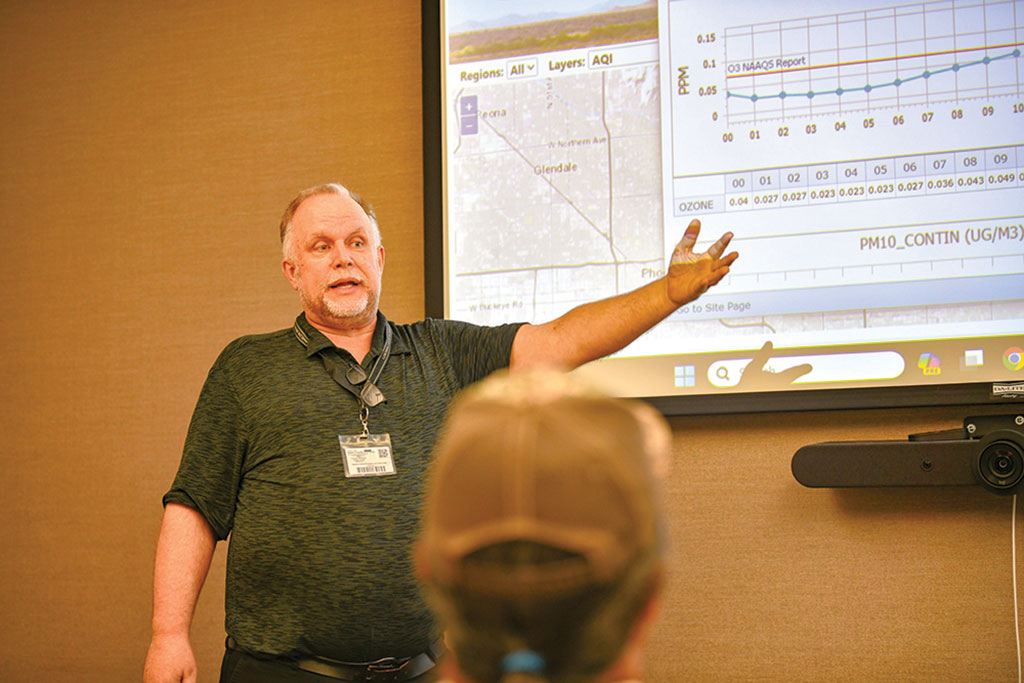
For the division’s second scheduled presentation in the education series, Salt River Project staff were invited to share their knowledge on different types of electrical shock, identifying risks when dealing with potential electrical shock and best practices for different scenarios.
The first suggestion? “Call us,” said Maximus Sego, senior safety and health specialist with SRP. Sego, who facilitated the presentation, does a lot of outreach on workplace safety. “An ounce of prevention is worth a pound of cure, as the saying goes.”
Sego advised that before undertaking any project, it’s important to look above, below and around the jobsite for potential hazards. If your work is taking place near overhead power lines, the standard minimum approach distance of 10 feet is recommended. Treat every power line as energized.
Power lines can be identified pretty easily above ground, but they can just as easily be running underground, out of sight. That’s why it’s important to call 811 or Blue Stake before beginning any projects that involve digging.
“Even if you’re planting one tree, call and have them map out what’s running underground before you dig,” Sego said. He suggests marking where you’re planning to dig to get the clearest answer and find alternative approaches if necessary. “If you dig down and hit a wire, you’re not just risking electrical shock, but also a lot of headaches downstream from the damage,” he added.
Even if you have no plans to work around electrical equipment, there’s still the possibility of encountering a downed power line, an increasing risk as monsoon thunderstorms and El Niño loom in the forecast. If you are in an accident that takes down a power line or encounter one on your commute, it’s important to always assume the lines are energized. Do not touch a downed power line. Instead, call 911 and they will contact the appropriate parties to responsibly handle the situation.
This is especially important in the event of a vehicle collision where contact is made with wires. Because electricity flows much like water through a pipe, contacting the energized lines can add you and your vehicle into the circuit, an invisible risk that isn’t apparent until the circuit is broken and energy is released in the form of an electrical shock.
A specific technique is required to exit a vehicle or equipment that has come into contact with a power source and may be electrically charged. In this dangerous scenario, it’s best to stay in the vehicle. What’s called “step potential exposure” can put each foot into a different voltage area if they are spaced too far apart, which causes the electrical charge to be released into the person conducting it. The electricity moves between the two ranges, using the person as a path. That’s where the hop-shuffle technique comes in. This technique should only be exercised if you are unable to remain in the vehicle until help arrives. First, the person needs to jump out of the vehicle and land on their feet, with both feet together. Then, they must shuffle their feet across the ground without breaking contact until they are a safe distance away, at least 30 feet.
As the presentation ended, Sego shared his five rules to prevent opportunities for electric shock (see sidebar). SRPMIC staff and employees left with a greater understanding of electrical shock risks and the knowledge about how to maintain safety for themselves and others should they ever find themselves working around power lines and other electrical hazards.
The next presentation from the Community Risk Reduction Division will be on Sept. 8 for National Preparedness Month, highlighting Salt River Emergency Management: Personal, Home and Community Preparedness Training.
5 Rules for Preventing Electrical Shock
01 Assume energized: Every power line is dangerous until confirmed otherwise.
02 Look up and around: Check before moving equipment, materials or ladders.
03 Maintain clearance: Use SRP public safety and OSHA crane clearances.
04 Call 811: Use safe excavation practices around underground utilities.
05 If contact occurs, stay where you are, warn others, call 911/SRP, and shuffle/hop only if necessary.
Bottom line: When distance, voltage or ownership is uncertain, stop and verify before continuing.