VIEWS: 1392
August 12, 2026Salt River Fire Department and National Weather Service Team Up for Severe Weather Training
3 Takeaways:
- A training session on severe weather was held on July 7 at Two Waters.
- SRFD Fire Captain Bobby Scabby welcomed guests, who included Tom Frieders from the Phoenix branch of the National Weather Service.
- Additional free training sessions are scheduled in the coming months.
Salt River Fire Department Captain Robert Scabby smiled from ear to ear as guests slowly made their way into Room 109 inside Two Waters Building A on the morning of July 7.
Guests filed into the room for the debut class of a three-part Community safety training that covers the monsoon, electrical awareness and Community preparedness during emergencies.
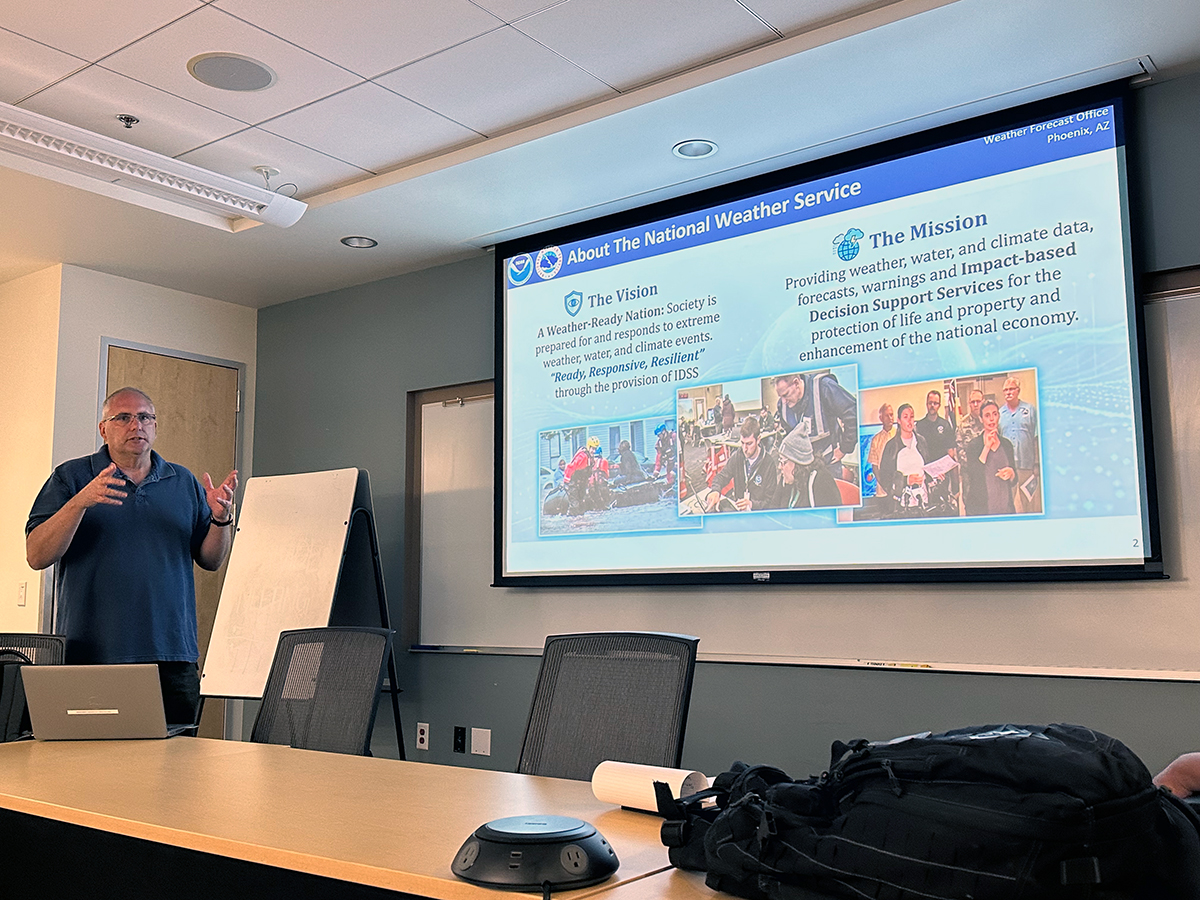
National Weather Service Warning Coordination Meteorologist Tom Frieders provided tips on how families can stay safe this monsoon season as a Super El Niño continues to inch its way toward Arizona bringing high winds and ample rainfall.
“We received a lot of feedback from the Community on this training,” said Scabby before the presentation began. “We’re happy to host this one and also the next two. There is some good information here.”
Frieders began by acknowledging a microburst storm that ripped through Lehi in July 2022. “I know the Community was hit hard [in] that microburst …. Power lines came down, and a lot of challenges came after that event,” he said.
During his presentation, Frieders detailed how he collaborates with local aviation, police and fire authorities, as well as the public. “If a plane leaves New York and tries to land in Phoenix in the afternoon [during monsoon season], the pilots want to know what the weather is going to be like.”
He also added that his work monitors potential wildfire outbreaks. “Currently, we have some really dry vegetation out there that’s ready to burn. Any kind of significant hot, dry and windy conditions that develop, we keep an eye on that and coordinate with our fire partners,” he said.
Revealing to the group that he has been working and living in Phoenix for the past six years, Frieders said the recent monsoons have been causing unfathomable destruction to property and homes, which also brings expensive repair costs. “On average, nationwide we experience around $20 billion in annual damage from disasters,” he said. “In the early 2000s it was around $7 billion.”
The increase can be attributed to the severity of storms. Though they may not last that long, recent storms have been statistically more powerful, with more severe winds and rainfall.
Later, Frieders discussed lightning strikes and how to stay safe if you find yourself outdoors during a thunderstorm.
“A lightning bolt is 50,000 degrees instantaneously, so do not stand under a tree,” advised Frieders. “If you’re outdoors and caught in a lightning storm, the safest location to seek shelter is inside your vehicle. If it’s struck, the car’s cage will redirect the electricity from the lightning bolt into the ground.”
He mentioned that a National Weather Service colleague of his had to seek shelter inside his car during a lightning storm and thankfully survived. “He told me it wasn’t a pleasant experience to go through, but he’s here to tell others about it,” he said.
Frieders said lightning occurs when a positive charge is created inside the clouds 10,000 to 12,000 feet above us. The positive charge searches for a negative charge on the ground or on a tall object, like a tree or building. “It’s similar to when you rub a balloon on your arm. Ice particles and raindrops rub against each other inside the clouds, and they develop a positive charge at the base of a thunderstorm.”
He continued, “As those opposite charges start to attract more, if you’re in that vicinity, your hair is going to start to stand on end because it’s being attracted to that pull. That’s a good indication of a lightning strike that’s nearby.”
Frieders suggested finding shelter or a safer area and waiting until the storm passes through.
Frieders also talked about flash floods. “If you ever see water flowing across the road, we use the phrase ‘Turn around, don’t drown.’ One foot of water can wash away a vehicle.”
He suggested that individuals avoid using corded house phones during lightning storms. “If the house is struck, that electrical energy could go through the wires and into the phone receiver. The same applies to certain plumbing as well. Don’t take showers during a thunderstorm.”
Scabby thanked Frieders for his presentation and added that Community members can ensure they and their loved ones are prepared by contacting Fire Prevention: email fireprevention@srpmic-nsn.gov or call (480) 362-7733.
The next class will be for National Preparedness Month on Sept. 8 at Two Waters Building A, Room 109.