VIEWS: 430
March 10, 2026Cultural Awareness Program Informs Seasonal Employees Before Spring Training
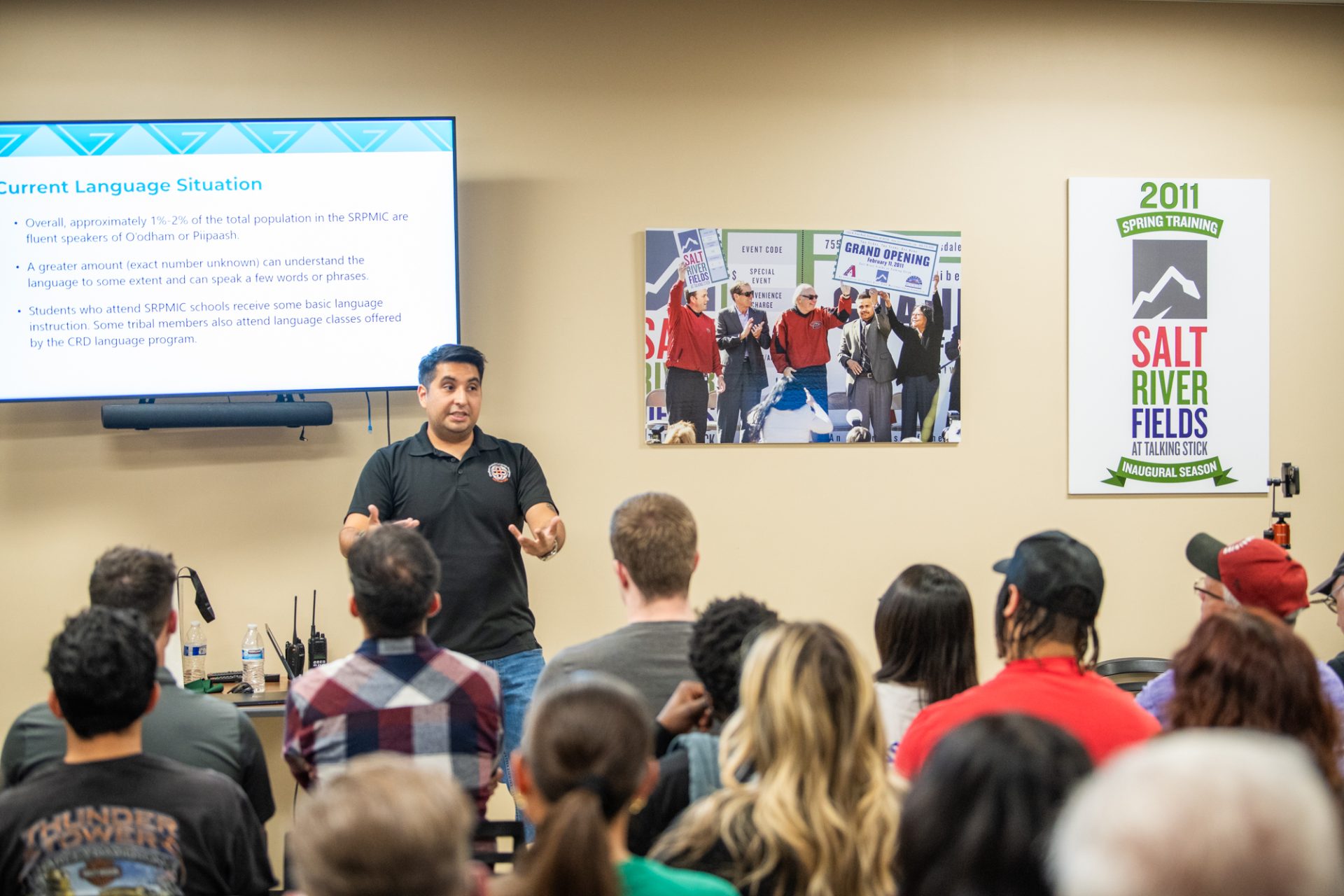
“Let’s take a little time to all learn together, all right?” Cultural Resources Department OPLP Outreach Coordinator Cody Achin asked a group of seasonal spring training employees at Salt River Fields on Feb. 10.
Achin led a call-and-response.
“Start with that first word,” he said, pointing to the greeting displayed on the screen.
“Ske:g.”
The group followed his cue.
“Ske:g,” a few voices echoed.
“O’odham speakers—every one of you already,” Achin joked.
Two groups of front-of-the-house seasonal employees gathered at different times for the Cultural Awareness Program led by Achin to learn about the history, culture and language of the Salt River Pima-Maricopa Indian Community ahead of the spring training season.
As front-facing staff, they are often the first people who greet Salt River Pima-Maricopa Indian Community members and their relatives attending baseball games.
The greetings the employees learned were Ske:g Taṣ (“good day” in O’odham) and Kamduum? (“how are you?” in Piipaash).
3 Takeaways:
- Seasonal front-of-the-house employees learned about the history and culture of the Salt River Pima-Maricopa Indian Community.
- The Cultural Awareness Program is led jointly by Discover Salt River and the SRPMIC Cultural Resources Department.
- Cody Achin taught the employees about the Community’s greetings and languages and the experiences Community members faced in boarding schools, among other topics.
The Cultural Awareness Program, also known as CAP, began two years ago as a joint initiative between the SRPMIC Community Development Department’s tourism division, Discover Salt River, and the Cultural Resources Department.
The program has worked with a variety of businesses within tribal boundaries to provide an educational space for employees, business owners and business partners to learn about the Community’s history, culture and language, said Salt River Tourism Supervisor Jessica Sepulveda.
“We believe the Cultural Awareness Program is vital in sharing the message that while we technically have a ‘Scottsdale’ address, we are the Salt River Pima-Maricopa Indian Community,” said Sepulveda.
“The language presentation given today by Cody Achin was an invitation to Salt River Fields staff to use our language and welcome guests to Salt River Fields during the upcoming spring training season.”
Achin gave the group “a firsthand okay” to say the greetings in the Community’s languages.
“We’re giving you that space,” Achin told the employees.
“We’re giving you that time to make mistakes, and it’s okay if you are not perfect at it. We’re only asking as a community that you at least try.”
As employees practiced the words, some pulled out their phones to record the pronunciations of the greetings.
But greetings weren’t the only topic. Achin also touched upon the history of Native American boarding schools and the generational trauma and damage that the schools have caused.
“These kids were often taken from their families as young as 2 or 3 years old, placed and housed [in boarding schools] until they graduated between the ages of 18 and 26, depending on when [school leaders] deemed them [fully assimilated],” Achin informed the group, before going into more graphic detail of what the children went through.
Achin shared with the group that many of those students eventually became parents who taught their own children to speak English only, in an effort to protect them from enduring the same suffering they had.
He tied the boarding schools lesson to the Community’s greetings, reminding them how even the simple gesture of using greetings in O’odham and Piipaash can make a big and lasting impact on Community members and the general population.
“It wasn’t that long ago that our parents and grandparents were in these schools, and so even though those schools are shut down, and even though these atrocities aren’t happening anymore, the effect of these boarding schools is still being felt today,” said Achin.
“It’s a big reason why we don’t have as many speakers as we could, and why we’re still trying to pick up the pieces just teaching people the basics.”
Armed with a deeper cultural understanding of the Community on which Salt River Fields is located, the employees are now ready to greet the Community throughout the upcoming spring training season.
“The feedback we received from the Salt River Fields staff that attended the presentation was incredible, and they are all very eager to greet guests in our languages,” said Sepulveda. “We are looking forward to hearing it this season and for the greetings to continue in future seasons.”